Anatomy of a wine (CSI: RIOJA)
What does wine actually smell like?
We've all seen that movie scene — someone picks up a glass of red wine, brings it to their nose, and delivers the line: mmm… red fruit, a touch of vanilla, a hint of clove. In this article, I'm going to tell you, with data, why that wine is likely young — and why, when it's had some barrel ageing, those aromas shift to leather, tobacco, or that earthy note tasters call "forest floor."
The concept you need to keep in mind from the start is that you're not smelling fruit, or vanilla, or tobacco. What you're smelling is the chemical fingerprint of millions of microorganisms that did their job over months or years — along with the exact conditions in which they did it.
Every aroma you perceive has a first and last name: a specific chemical compound, produced by a specific organism, during a specific stage of the process. Once you understand this, you can leave the winery owner speechless by telling them the story of their own product.
Let's go.
The fifth element of wine (Phase 1)
When we talk about TERROIR — a French concept that tries to explain why a wine tastes like a place, much like goat cheese tastes like the goat's pen — we usually mention soil, climate, altitude, slope orientation. All of which are hugely important for grape production, but we often overlook the grape's microbiota.
Before anyone treads a single grape, its skin already harbours a complex ecosystem. Yeasts like Hanseniaspora, Metschnikowia and Candida coexist with acetic acid bacteria, lactic acid bacteria and dozens of other microorganisms, whose composition varies by region, grape variety, year, and even the plot within the same vineyard.
This has direct implications. When a winemaker decides to carry out a fermentation with "indigenous yeasts" — that is, without inoculating a commercial strain of Saccharomyces cerevisiae — they're betting on that local ecosystem. The result can be a wine with more complexity and sense of place, or an undrinkable disaster. There's no middle ground, and that's precisely the gamble that keeps oenology exciting.
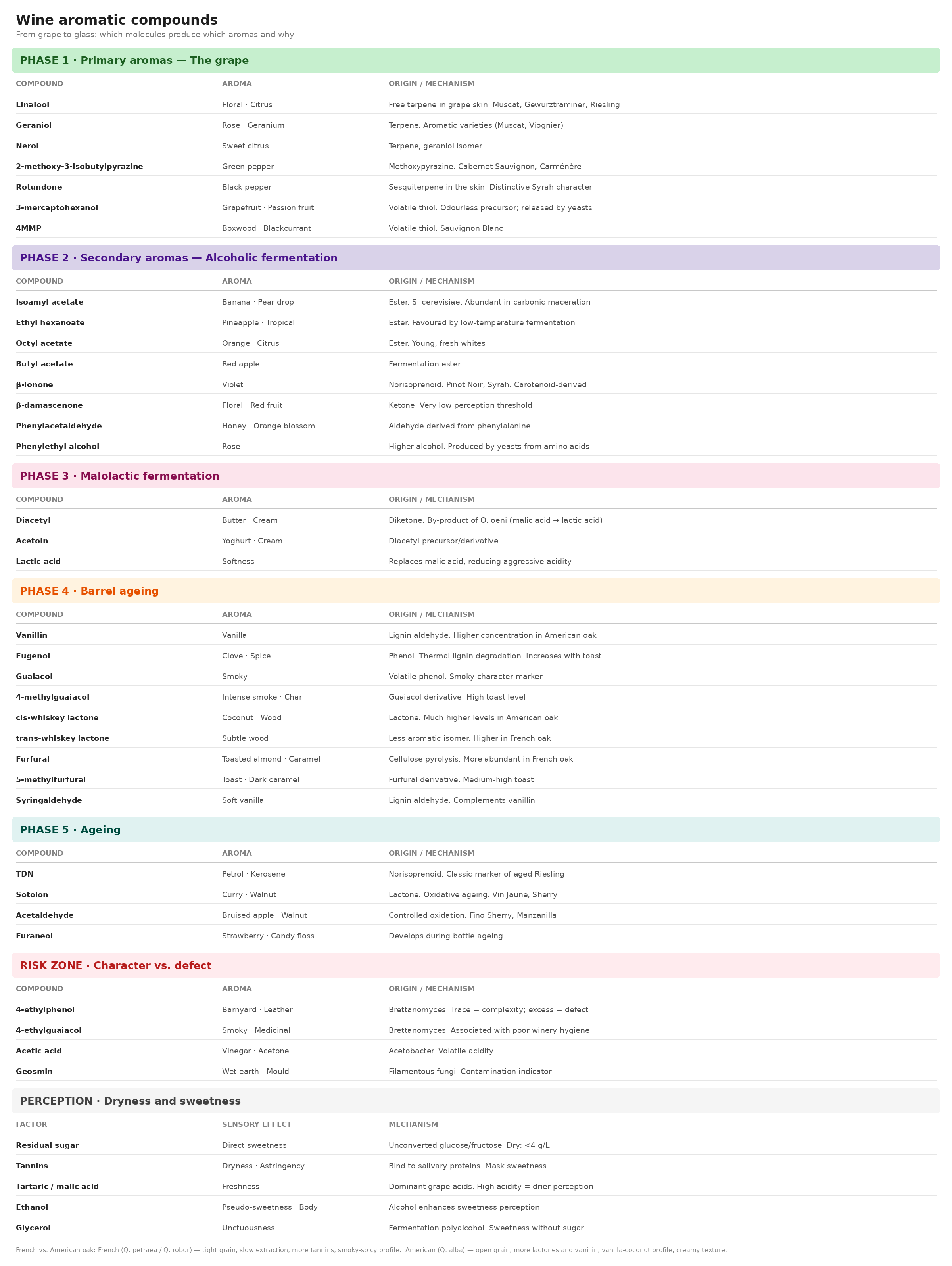
Some compounds are already in the grape and pass directly into the wine. Terpenes are the cleanest example: linalool produces floral and citrus notes; geraniol evokes rose petals. They're the reason a Muscat or a Gewürztraminer smells the way it does — the grape's genetic variety expressing itself as volatile molecules.
Methoxypyrazines — specifically 2-methoxy-3-isobutylpyrazine — are the culprits behind the green pepper aroma of Cabernet Sauvignon. And rotundone, a sesquiterpene, is responsible for the black pepper character of Syrah. These aromas are called "primary" because they don't need fermentation to exist; they're already there.
But other compounds are more subtle. Volatile thiols, for example, don't exist as aromas in the must. They're present as odourless conjugates bound to cysteine — silent precursors that need a yeast to release them during fermentation. They're responsible for the grapefruit and blackcurrant notes of Sauvignon Blanc. The grape has them, but you can't smell them until a microorganism steps in.
And that's where things get interesting.
Alcoholic fermentation: what happens while you think only alcohol is being produced (Phase 2)
Most people understand fermentation as a simple process: yeasts eat sugar and produce alcohol and CO₂. This is true, but it's like saying cooking is "applying heat to food." Technically correct, radically simplistic.
Saccharomyces cerevisiae — the lead yeast in alcoholic fermentation — produces, in addition to ethanol, hundreds of secondary metabolites. And it's these compounds that determine how the wine smells. Esters are the most important group. They're molecules formed by the reaction between an acid and an alcohol, and each ester has a distinct aromatic profile:
Isoamyl acetate smells of banana and pear drops.
Ethyl hexanoate produces tropical pineapple notes.
Octyl acetate delivers citrus and orange.
Butyl acetate gives red apple.
If you've ever smelled a very young Beaujolais with that almost artificial fruity character, you're smelling this ester, which is produced abundantly during carbonic maceration.
What determines which esters are produced and in what quantity is not random: it depends on the yeast strain (commercial or indigenous), the fermentation temperature, the nutrients available in the must, and the speed at which the process occurs. A cold, slow fermentation produces more aromatic esters — that's why many whites ferment at controlled temperatures of 12–16°C.
But it's not all esters. Beta-ionone, a compound that produces the ghostly violet aroma in Pinot Noir and Syrah, is formed during fermentation. Higher alcohols — with more carbon atoms than ethanol — contribute to complexity and body, though in excess they can produce unpleasant solvent-like notes.
There's a point I think is fundamental to understanding what separates a good wine from a mediocre one, and there's nothing romantic about it: it's microbiological management. The winemaker who controls the temperature, selects the yeast, adjusts the nutrients and monitors fermentation kinetics is, like a professional organist, directing which secondary metabolites are produced. It's applied microbiology with an organoleptic objective.
After alcoholic fermentation, what you have is technically wine — it has alcohol, it's no longer must — but it's not ready to sell as is. It still needs to go through several cleaning and stabilisation stages:
Racking and transfer
Malolactic fermentation
Clarification and filtration
Stabilisation
Sulphiting
And from there, the path forks. If it's going to be a young wine, it's bottled directly. No barrel. These wines are sold in the spring following the harvest and are the ones that preserve the maximum primary and secondary aromas — banana, fresh fruit, flowers. If it's going to be a crianza, reserva or gran reserva, it goes into barrel, and that's where Phase 4 kicks in with all the oak chemistry — but we'll get to that later.
Malolactic fermentation: how a bacterium turns an aggressive wine into a smooth one (Phase 3)
Once alcoholic fermentation ends, many red wines — and some whites — go through a second fermentation that has nothing to do with yeasts. Here, the yeasts go on holiday. Malolactic fermentation is carried out by lactic acid bacteria, primarily Oenococcus oeni, and consists of converting malic acid (aggressive, like that of a green apple) into lactic acid (soft, like that of yoghurt).
The immediate result is a less acidic, softer wine on the palate. But the truly interesting by-product is diacetyl — a diketone that smells of melted butter. If you've ever had a Chardonnay with that creamy, unctuous character that reminds you of buttered popcorn, you're perceiving diacetyl produced by bacteria during malolactic fermentation.
The concentration of diacetyl is a matter of balance. In low doses it adds creaminess and complexity. In excess, the wine literally smells of rancid butter. The difference between "complexity" and "defect" is, once again, a matter of controlling fermentation.
A detail I find rather neat is that not all wines go through malolactic fermentation. In many whites it's deliberately prevented in order to preserve acidity and freshness.
The barrel is an ecosystem, not a piece of furniture (Phase 4)
We tend to think of the barrel as an inert container that adds "woody flavour" and eventually ends up as table legs on a bar terrace. The question is: why is it always made of wood, and why hasn't it been replaced with inert materials with different properties — plastic, glass, or metal?
Because wood — understood as a living material — contributes three very important properties. It's a source of chemical compounds, a system of controlled micro-oxygenation, and it has its own microbiota.
When wine comes into contact with oak wood, it begins extracting compounds from the lignin, cellulose and hemicellulose. The main ones:
Vanillin is the same compound that gives natural vanilla its flavour — in wine, it's extracted directly from the oak's lignin. Eugenol is the main molecule in clove spice — in toasted oak, it's produced by thermal degradation of lignin and delivers those characteristic spicy notes. Guaiacol provides a smoky character. Furfural and 5-methylfurfural deliver toasted almond and caramel notes — produced by the pyrolysis of cellulose during the barrel's toasting. And whiskey lactone (cis-methyl-octalactone) produces oak and coconut aromas, with an extremely low perception threshold.
Now, not all wood is the same, and here lies one of the most influential — and poetic — decisions in winemaking: the choice between French oak and American oak.
French oak (Quercus petraea and Q. robur) has a tighter grain, which slows down the extraction of compounds. It produces higher concentrations of furfural and 5-methylfurfural, generating smoky, liquorice and toasty aromas. It contributes more ellagic tannins, which add structure and longevity. It gives a more subtle, drier profile.
American oak (Quercus alba) has a more open grain and is richer in lactones. Specifically, the levels of cis-whiskey lactone in wines aged in American oak are significantly higher than in those aged in French oak. The result is more pronounced notes of vanilla, coconut and sweet spices, with a creamier texture and a more direct character.
The degree of barrel toasting adds another layer: a heavy toast increases the compounds derived from lignin degradation (more eugenol, more guaiacol) and decreases the concentration of whiskey lactone. In other words, the higher the toast, the more smoky and spicy, the less coconut and wood.
Beyond extraction chemistry, through the porosity of the wood the wine receives a minimal, constant amount of oxygen: micro-oxygenation. This slow process transforms aggressive tannins into softer, polymeric tannins, contributes to colour stabilisation, and enables chemical reactions that generate new aromatic compounds. It's controlled oxidation on a timescale of months, and the wood acts as the regulator.
Dryness and sweetness: more complicated than it seems (Phase 5)
Let's look at what "this wine is dry" actually means.
Technically, a dry wine contains less than 4 grams of residual sugar per litre — what's left after the yeasts have converted the bulk of the sugar into alcohol. So the longer the fermentation, the drier the result.
But that's not the end of it. The perception of dryness is something far more complex. Tannins play a fundamental role: they're astringent, they bind to salivary proteins and reduce mouth lubrication, producing that sensation of dryness that's sometimes confused with a lack of sugar. A red wine with high tannin levels can have residual sugar and still feel completely dry. Tannins act as a sensory distraction that masks the perception of sweetness.
Acidity also counteracts sweetness: a Riesling with notable residual sugar can feel balanced and not cloying if it has enough acidity. Alcohol, paradoxically, can enhance the perception of sweetness — that's why a dry Viognier can seem slightly sweet. As in haute cuisine, the wine's result can be subtly redirected to achieve a unique flavour through small nuances that bring balance.
And on top of all this, there's something very curious: with wines, something similar happens to what occurs with perfumes — the same perfume can smell different on two different people. You can have two wines identical in residual sugar, acidity and pH, and one tastes drier than the other. This is due to the buffers inherent in the wine and the individual genetics of the taster. Even the composition of your saliva — how much sodium, calcium and enzymes it contains — can change your perception of sweetness. It's an interaction between the chemistry of the wine and the biochemistry of your mouth.
The fine line between character and defect: Brettanomyces and the ecology of chaos
And now we reach the part that, for a microbiologist, is perhaps the most fascinating.
Brettanomyces bruxellensis is a yeast that produces two volatile phenolic compounds: 4-ethylphenol (4-EP) and 4-ethylguaiacol (4-EG). At low concentrations, these compounds can contribute notes of leather, spice, or a slightly animal character that some tasters associate with complexity and "rusticity." Certain wines from the Rhône and Bordeaux have traditionally had a subtle Brett presence that formed part of their organoleptic identity. But at high concentrations (4-EP > 400 µg/L, 4-EG > 135 µg/L, and the sum of both > 600 µg/L), the same compounds produce aromas of stable yard, horse sweat, medicinal notes, or sticking plasters. The wine goes from "interesting" to "faulty" without the type of molecule changing — only the concentration.
Back to the tasting scene
Now try tasting that wine you have next to you and piece together the facts. You now know that the vanilla you detect is vanillin extracted from the oak's lignin because the winemaker chose an American oak barrel with a medium toast. That the buttery character is diacetyl produced by Oenococcus oeni during a malolactic fermentation that was allowed on purpose. That the banana aroma of that young wine is isoamyl acetate synthesised by Saccharomyces during a cold fermentation. That the black pepper of that Syrah is rotundone, a terpene that was already in the grape's skin. And that the subtle leather undertone is 4-ethylphenol produced by Brettanomyces at concentrations low enough to add rather than subtract. Every aroma is an entry in the log of everything that happened from vineyard to table — which organisms intervened, under what conditions, under what degree of control.
It seems this wine has notes of vanilla and a spicy touch with a long finish. What must have happened?
Now you can read the wine and, closing your eyes, see the scenes of its production like a CSI episode.
Spoiler: the vanillin and eugenol from that oak barrel integrated well with the fermentation esters, and the tannins are polymerised enough not to mask the aromas.