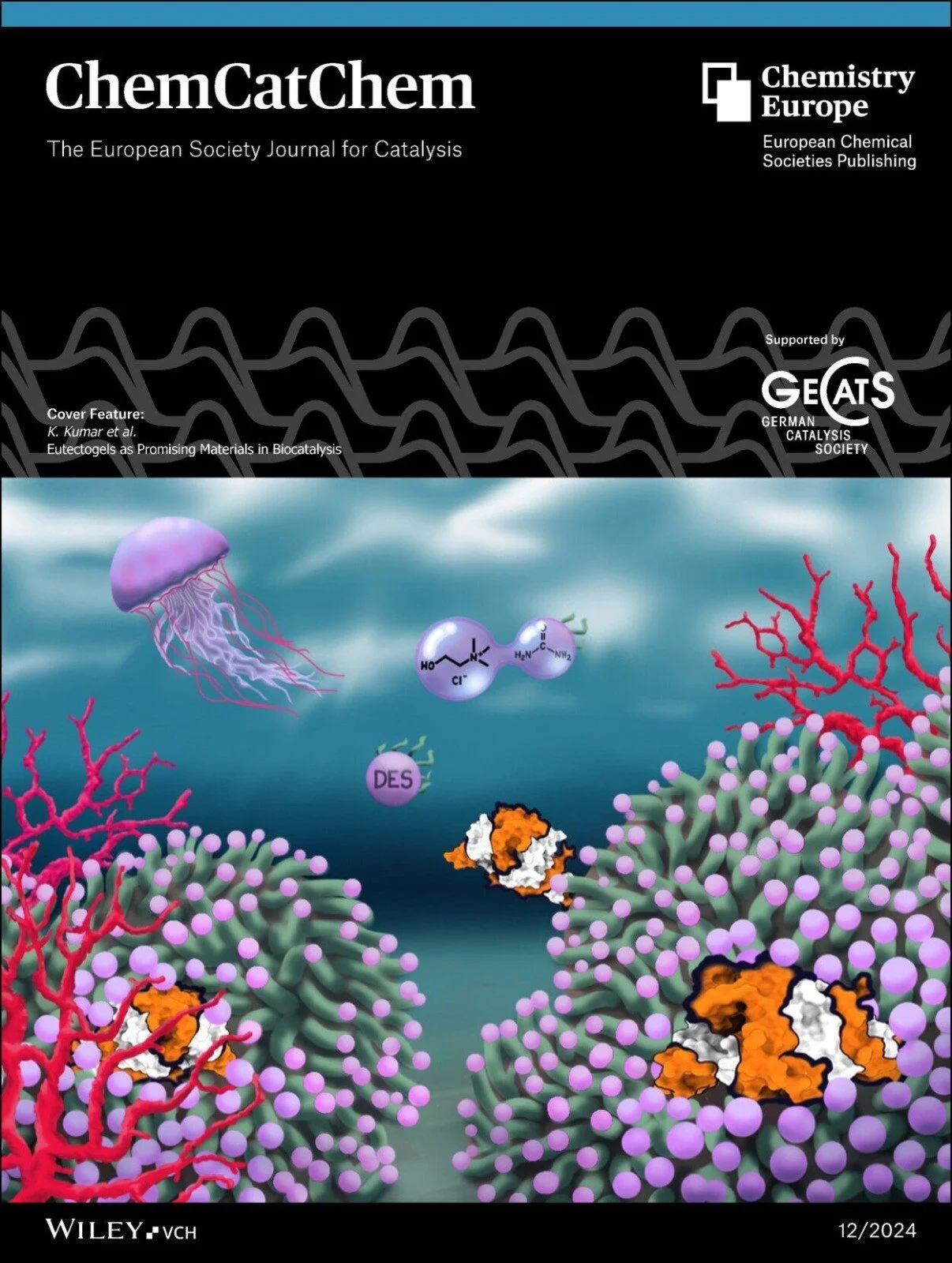
Eutectogels as Promising Materials in Biocatalysis
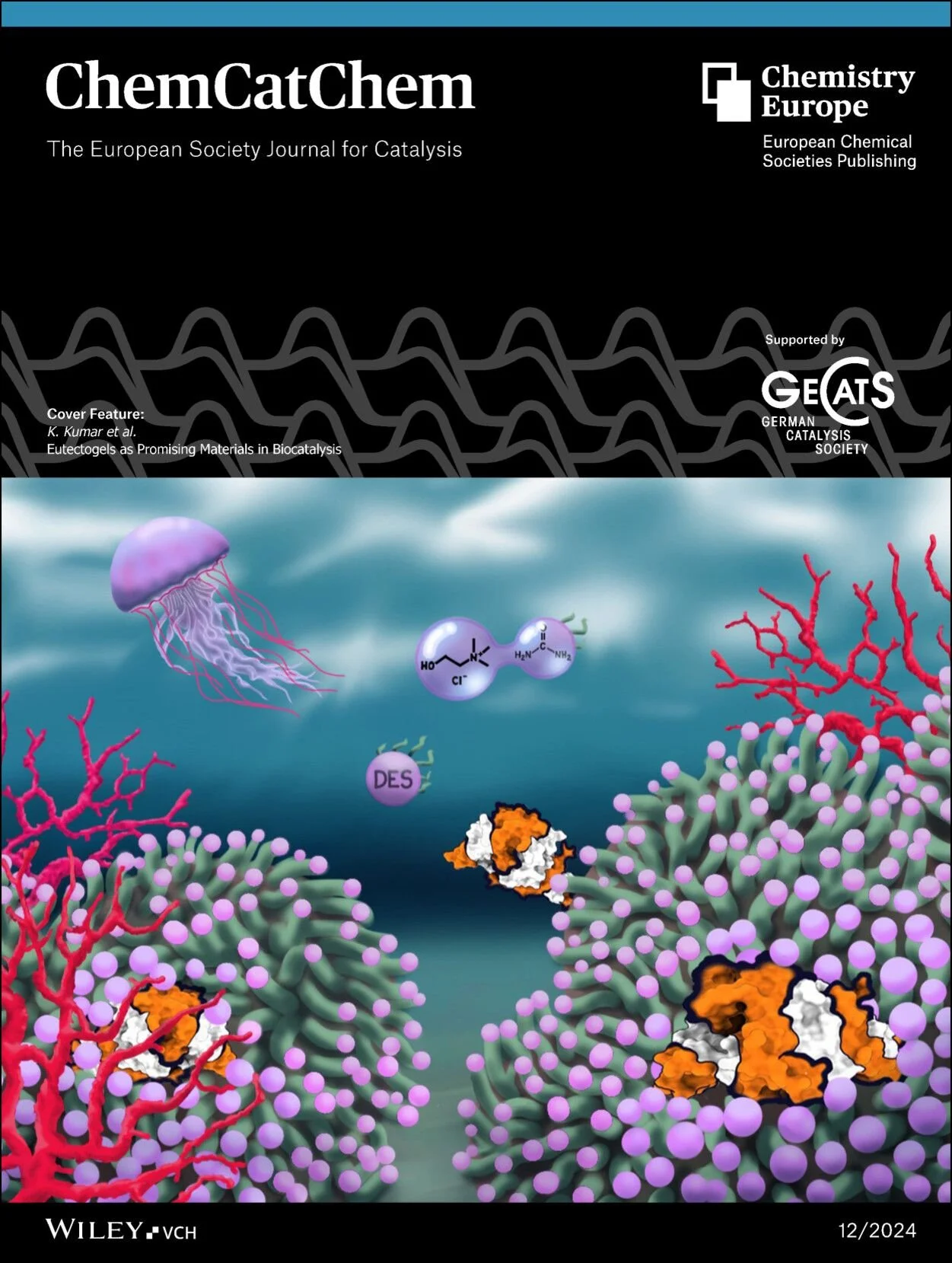
About it
Prof. Marcelo Calderón and Dr Ana Beloqui joined forces to present a promising perspective on the use of Deep Eutectic Solvents (DES) across multiple scientific applications. The result was published and featured in ChemCatChem: Volume 16, Issue 12.
Roles: Conceptualisation, Illustration
Client: POLYMAT & Euskal Herriko Unibertsitatea
Tools: Photoshop
The Challenge
The study explored the use of deep eutectic solvents to stabilise enzymes and eventually immobilise them through polymerisable DES. The cover needed to make that chemistry feel tangible and layered, ideally through a single visual system that could carry multiple readings without feeling forced.
The Process
The connecting thread came from reef biology. At first glance, anemones and enzyme stabilisation have nothing in common, but the parallels kept stacking up. DES forms a structured envelope around a protein, providing structural protection, much like the symbiotic relationship between anemones and clownfish. That became the core metaphor: clownfish as proteins, anemone as DES. The 3D protein characters were modelled and coloured in ChimeraX, then refined in Photoshop to fit the illustrated scene.
From there, the cnidarian life cycle opened up a second layer of meaning. Anemones can reproduce asexually by segmentation, releasing jellyfish (which are themselves gel-based organisms), and those jellyfish can reproduce sexually through gametes to generate new polyps. Viewed abstractly, the idea of two mobile organisms producing a sessile offspring mirrors how DES works: two solid components whose interaction lowers the melting point, forming a new liquid medium. That parallel gave the composition its structure.
A third narrative thread ran through the whole image: safe space versus danger zone. Inside the anemone (inside the DES), the clownfish proteins are protected. Outside, they are exposed to predators. The jellyfish doubled as the threat itself, standing in for protein denaturation.
Finally, the paper's section on polymerisable DES for protein immobilisation found its visual counterpart in coral formations, whose branching structures echo hexagonal ring geometries and the radical-driven polymer growth proposed in the work.