When everything fails in bipolar depression
About it
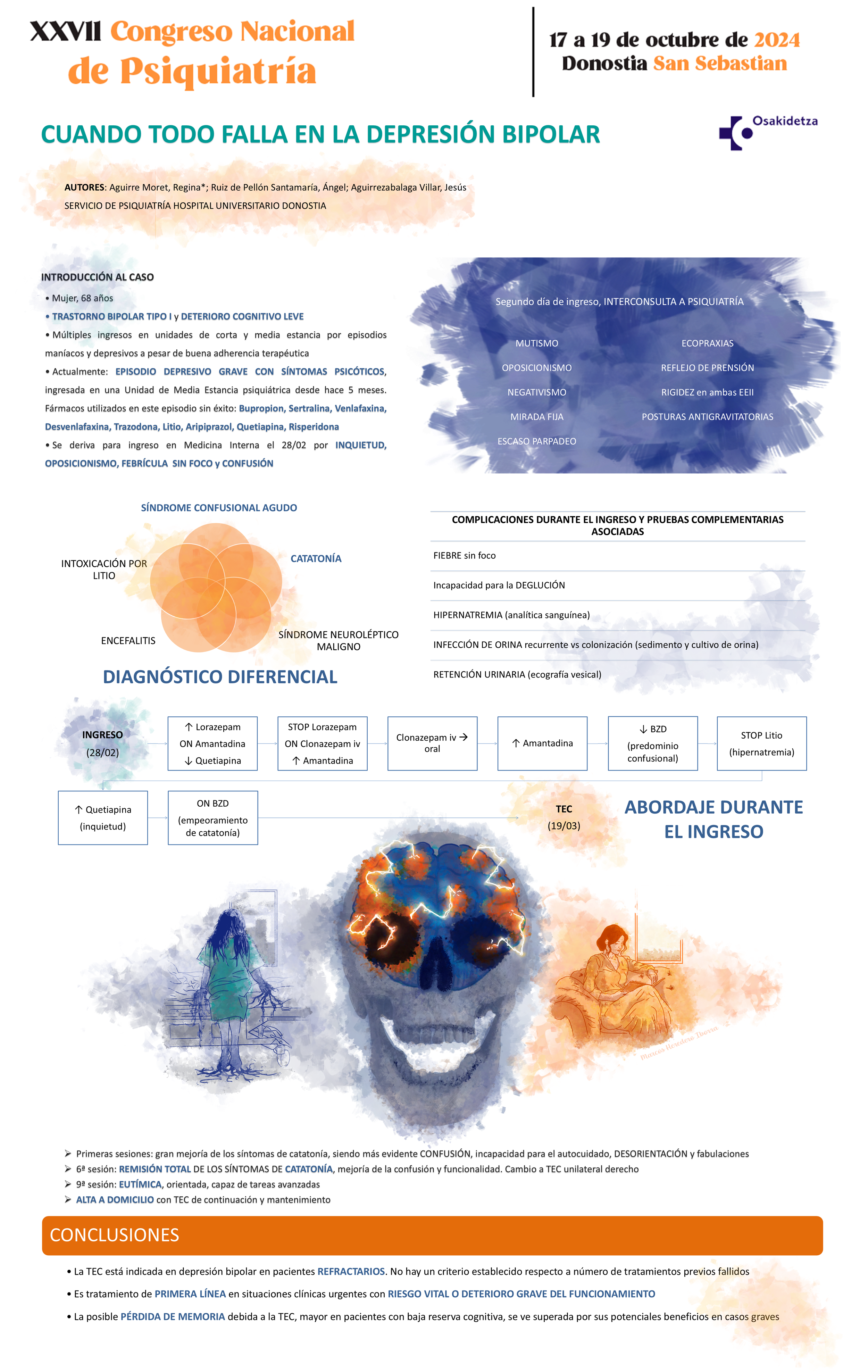
This Poster was created for Regina Aguirre Moret and coworkers to present a practical case at the Spanish National Congress of Psychiatry. Their work demonstrated the benefits of using electroconvulsive therapy (ECT) for a long-term resistant depression patient.
ECT involves applying a controlled electrical current to the patient's brain under anaesthesia, causing a brief seizure. Although it sounds shocking, it has been used safely and effectively for decades. Although it is not the first treatment option, ECT offers hope when other approaches fail to produce results, significantly improving patients' quality of life.
ECT began to be used in the 1930s. Although its application was not without controversy in its early days, medical advances have refined the technique, making it much safer and more comfortable for patients. Today, it is a valuable tool when other treatments have failed.
The Journey Behind the POSTER Design
In this work, we prepared multiple colour motifs to frame the different sections, based on the Congress colour palette.
Blue and turquoise: Catatonia, depression, tingling and depersonalisation.
Orange and yellow: Warmth, well-being, calm and tranquillity.
The election for watercolour strokes was chosen, thinking about the feeling of confusion, an overlaid thought stream, and mind cloudiness, which evokes depression.
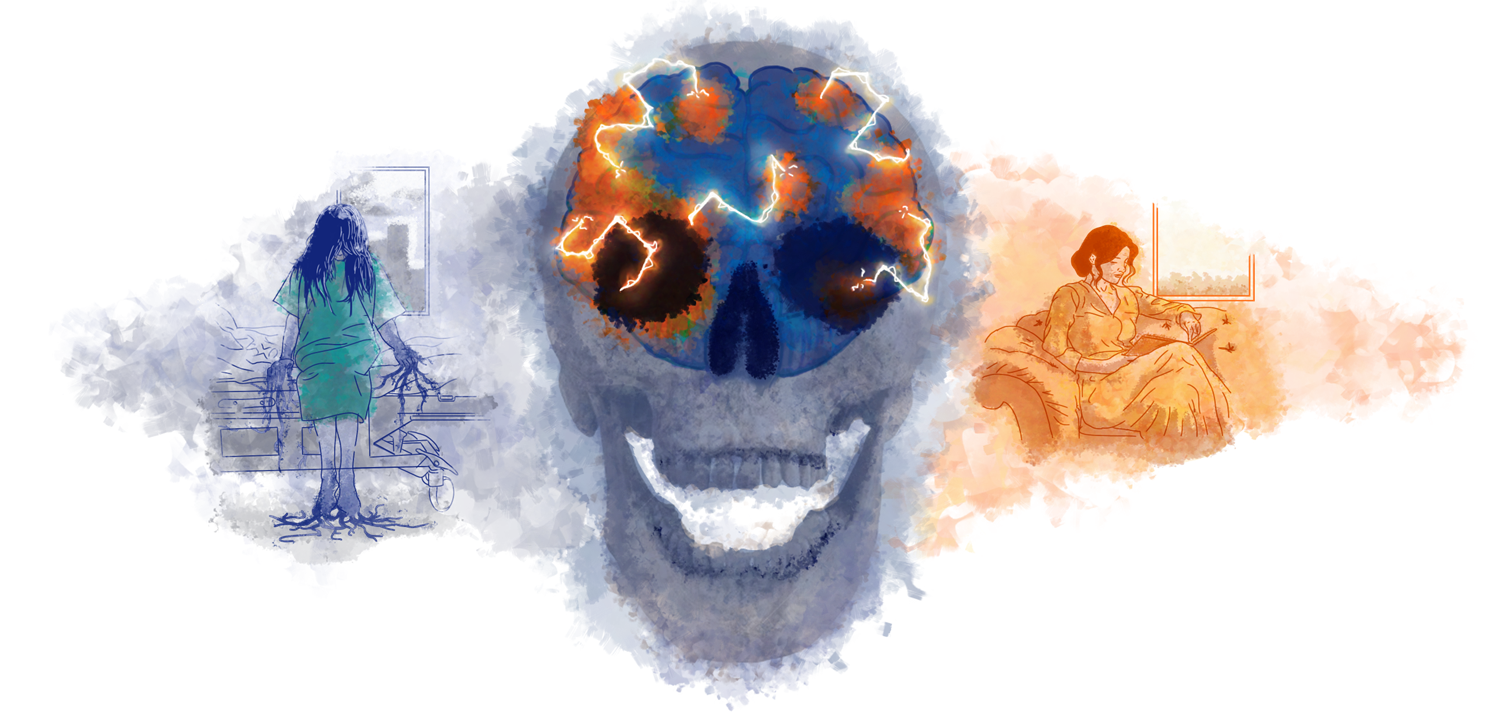
Our biggest bet was the central picture that was intended not to let anybody be indifferent. It is not so common to find an expressive skull in such contexts, so we decided to attract as much attention as possible with this disruptive strategy. The introduction of a sparkling brain healing in real-time, shifting from blue to orange, helped to introduce a bit of transition feeling to the figure.
On the side of the skull, we can see two persons representing the staff before and after the therapy. The left side is a catatonic woman who is putting down roots, turning away from the light that, depending on the mood, sometimes can be overwhelming. On the right side, in an opposite mood, we have an orange-toned depiction of the calm and well-being after the treatment. In which the woman is reading on a sofa, making use of the light to be comfortable.
In both cases, we have similar moments of a woman sitting down, immobile, affected by the daylight, but there is a great difference in the mood, and that was the objective to transmit.